The Hunger Crushing Combo Method Review: A New Way to Think About Food (Part 1)
Book Review: Introduction
A note before we begin: This post touches on diet culture, disordered eating, and eating disorders. If these topics are difficult for you personally, please take care of yourself as you read. If you or someone you know is struggling, the National Alliance for Eating Disorders website is available at nationaleatingdisorders.org.
Summary
This introduction to Abbey Sharp’s The Hunger Crushing Combo Method explores how modern diet culture has transformed the simple act of eating into a source of profound moral judgment, shame, and anxiety. By internalizing invisible rules that equate food choices with personal character, many individuals have become disconnected from their own biological wisdom and the evolutionary necessity of finding pleasure in nourishment. Sharp uses her own experience with orthorexia and sobering statistics on disordered eating to highlight the widespread mental and physical costs of this cultural obsession with "correct" eating. Ultimately, the text argues that a healthier relationship with food is possible by rejecting scarcity and rigid restrictions in favor of an evidence-based framework that prioritizes satisfaction, abundance, and body trust.
Introduction
If you've ever stood in the grocery store, paralyzed by whether a particular food is "clean" enough, or felt a flash of guilt after enjoying a meal you actually liked — you are not alone. And if you've ever wondered how eating, something we do every single day, became so complicated, so loaded, and so exhausting, I've been thinking about that very same thing.
I recently started reading
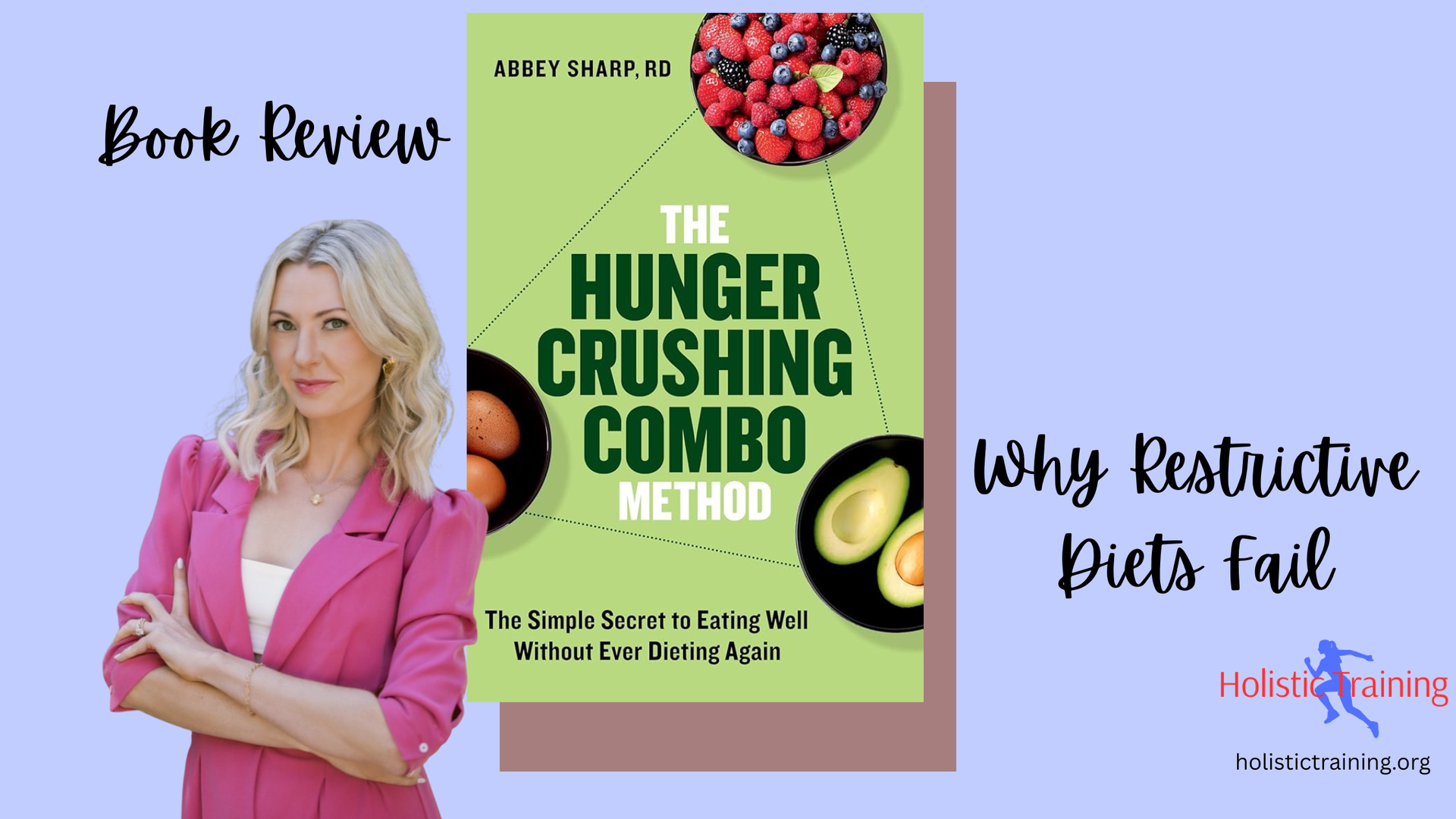
The Hunger Crushing Combo Method by Abbey Sharp, a Registered Dietitian, and it's already giving me a lot to think about. This is the first in a series of blog posts exploring the book as I read through it. Today I want to focus on Sharp's introduction — because before she gets into the method itself, she does something important: she names the problem.
Why Eating Well Feels So Complicated
Sharp opens with an observation that I think will resonate with almost anyone who's spent time interacting with diet culture: eating well has become "riddled with shame, morality, and judgement." Not just confusing — morally loaded. As if what you choose to put on your plate is a reflection of your character, your discipline, your worth as a person.
We live in a world overflowing with nutrition information — and yet most of us feel more confused, more anxious, and more disconnected from our own bodies than ever. That's not a coincidence. It's the result of an industry and a wider culture that profits from our insecurity. The more confused and ashamed we feel, the more products, programs, and plans we buy trying to fix ourselves.
Sharp captures just how deep this goes with a striking comparison: she writes that for many of us, reaching for a mini biscotti at the office now carries roughly the same emotional weight as having an affair with a coworker. It sounds absurd — and it is — but it also rings painfully true for a lot of people. That's how disproportionate food guilt has become.
What makes this particularly insidious is that these rules are, as Sharp observes, largely invisible. We don't experience them as external impositions. We experience them as our own thoughts, our own shame, our own failure. We've so thoroughly internalized the rules of diet culture that we police ourselves — often without even realizing we're doing it. The result, Sharp notes, is "a longtime struggle with body dysmorphia, dissatisfaction, and disconnect from your own internal wisdom."
Enjoying Food Isn't a Character Flaw — It's Evolution
Here's something worth sitting with: the pleasure you take in food isn't a weakness. It's not something to overcome, suppress, or earn back through exercise. It's biology doing exactly what it's supposed to do.
Sharp makes a compelling evolutionary argument: our enjoyment of food exists because it motivated our ancestors to seek out the energy and nutrients they needed not just to survive, but to thrive. Pleasure is the mechanism that kept our species alive. Diet culture has done something genuinely harmful in reframing that pleasure as a moral failing — something to be managed, minimized, and constantly negotiated with.
When we shame ourselves for enjoying food, we're not becoming healthier. We're working against our own biology.
The Real Cost of Diet Culture
Sharp doesn't just speak theoretically about the harm diet culture causes — she speaks from personal experience. She found herself deep in the grip of orthorexia, an obsessive preoccupation with eating "correctly," alongside IBS. Her relationship with food became so all-consuming that, as she puts it, her eating disorder became her.
Her story is more common than many people realize. Sharp cites research suggesting that approximately 30 million Americans across a wide range of cultures, genders, and age groups struggle with an eating disorder — and more recent data suggests these numbers have only grown (1,2). A survey of over 4,000 American women found that 65 percent reported behaviors consistent with disordered eating (3). And Sharp makes a point that I think is crucial: you don't need any existing genetic or mental health vulnerabilities to be at serious risk. This is a cultural problem, which means it's broadly distributed.
But even if you've never come close to a clinical diagnosis, it's worth asking what chronic food worry has quietly cost you. The mental bandwidth spent calculating and second-guessing every meal. The social moments shadowed by anxiety. The simple pleasure of eating that somewhere along the way got replaced by vigilance. These are real costs, even when they go unnamed.
What Is the Hunger Crushing Combo Method?
This is where Sharp's book becomes not just a diagnosis of the problem, but a path forward. She closes her introduction with a promise: a way of eating well that trades scarcity for abundance, fear for pleasure, and confusion for clarity. No rigid rules. No shame spiral. No list of forbidden foods.
The Hunger Crushing Combo Method is Sharp's framework for building meals that work with your biology rather than against it — designed to help you feel genuinely satisfied, nourished, and free from the exhausting cycle of restriction and guilt. I'll be going into much more detail about the method itself in future posts, but at its core it's about returning to something we've largely lost: trust in our own bodies and the wisdom they already carry.
A Different Relationship With Food Is Possible
What I find most compelling about Sharp's introduction isn't just the critique of diet culture — though it's a crucial and necessary one. It's the insistence that a different way is possible. That eating well doesn't have to mean eating fearfully. That nourishment and pleasure aren't opposites. That abundance, not scarcity, is the foundation of a healthy relationship with food.
I'll be continuing to read and share my thoughts on
The Hunger Crushing Combo Method in the weeks ahead. If this resonates with you — if you've ever felt exhausted by the noise of diet culture and wondered whether there's a better way — I hope you'll follow along.
References
1. Sharp, A. (2026).
The Hunger Crushing Combo Method.
2. Deloitte Access Economics. (2020). The social and economic cost of eating disorders in the United States of America: A report for the Strategic Training Initiative for the Prevention of Eating Disorders and the Academy for Eating Disorders. Harvard T.H. Chan School of Public Health. https://www.hsph.harvard.edu/striped/report-economic-costs-of-eating-disorders/
3. Bulik, C. M., & Reba-Harrelson, L. (2008, May). Disordered eating behaviors among American women aged 25–45. Survey conducted in partnership with SELF Magazine and the University of North Carolina at Chapel Hill. Presented at the 2008 International Conference on Eating Disorders, Seattle, WA.